
Evolution of drip irrigation
Surface drip irrigation
With this system, water is supplied to the soil surface from a pipe or tape through regularly spaced holes (emitters) which permit water to leak out slowly when the line is pressurised.
The emitters are designed to release water at a specific rate over a narrow range of line pressures.
Strengths
- Water can be applied to the root zone of a line of plants which reduces off target losses.
- Water does not wet plant foliage which lowers the risk of disease, of salt damage when water is saline and of food contamination from recycled water.
- Water losses from spray drift, and evaporation of aerosols and from wet foliage and soil are reduced.
- Soluble fertilizers can be delivered directly to the root zone in the irrigation water which reduces off target losses.
Weaknesses
- Drip lines lying on the ground interfere with cultivation and other farming activities
- Drip lines can be easily damaged by farm machinery, animals and insects
- Drip pipe and tapes are easily moved off the planting line by wind and farm activities
- The soil surface is wet which allows for evaporation and concentration of salts and encourages germination of weed seeds
Subsurface drip irrigation (SDI)
With this system, a surface drip pipe is buried around 150mm to 300mm deep close to the root zone of a crop. Burying the pipe, reduces the risk of mechanical damage and stops the pipe from moving off the planting line in wind.
Strengths
- Increased water use efficiency because water is released into the root zone reducing losses due to misapplication, spray drift, runoff and evaporation
- Increased fertilizer use efficiency because nutrients are released into the root zone reducing losses due to misapplication, volatilisation and uptake by weeds, and in surface flows of water
- Lower risk of salt injury because water does not contact the leaves. Salts will still be concentrated at the surface by evaporation but the area of wet soil is smaller.
- Lower risk of disease because plant foliage is dry and humidity within the crop is lower
- Lower risk that crops will be contaminated when recycled or polluted water is used
Weaknesses
- Uneven wetting of soil. Soil around each emitter becomes saturated causing structural damage and decreasing oxygen availability for roots.
- Tunnelling. Puddles of water appear on the surface at each irrigation event.
- Soil surface is wet allowing evaporation and establishing weeds
- High drainage/capillary. Saturation of the soil around each emitter favours drainage over capillary spread. This decreases the volume of soil within the root zone that can be wet by at each irrigation.
- Point source application means that emitters must be close together to create a uniform wetting pattern. Because there are more emitters their discharge rate must be lower. Low discharge emitters are more likely to block.
- The rate of water discharge from an emitter is much higher than the soil can absorb by capillary action and mass flow. The water is effectively injected under pressure into the soil and this causes local structural changes including particle segregation and loss of porosity.
- Roots may block emitters
Subsurface Textile Irrigation (STI)
Traditional SDI is nothing more than a surface drip line that has been buried to protect it from damage.
Subsurface textile irrigation is the first subsurface drip irrigation system that was designed to perform underground. The system mitigates most of the problems encountered when surface drip line is buried.
With the STI system, the drip pipe or tape is covered by a geotextile and an impermeable membrane which is continuous along its length (Figure 1). The product is 100mm wide and is laid in a concave profile in the ground.
Geotextile
The geotextile efficiently conducts the water from the emitters to the soil. The geotextile is highly porous and transmits water more than 10,000 times faster than the soil. It fills up rapidly with water and so helps to equalize supply along the length of the system.
The geotextile cover converts the pipe from a series of point source emissions into a continuous line source. The impact of this on the uniformity of the surface wetting pattern can be seen in the image below.
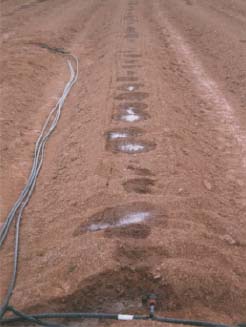
Traditional drip irrigation wetting pattern
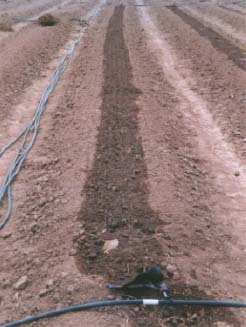
SISS textile irrigation wetting pattern
The geotextile also reduces the effective emission rate to the soil because the water is dispersed over the full area of geotextile. The material is 100mm wide and so the water emitted from a metre of STI is available to 1,000cm2 of soil.
Conventional SDI pipe discharges water into the soil that is adjacent to each emitter. Consequently, if there are 4 emitters in a metre of pipe and the area of influence around each emitter is 1cm2 then the total area of soil that must accept the water is only 4cm2.
Using STI, therefore, reduces the effective discharge rate of water by 250 times compared with traditional SDI. This reduces the volume of soil in the root zone that damaged when water is supplied under the ground
The discharge rate from even a 1L/hr emitter greatly exceeds the capacity of the soil to move it away through mass flow and capillary action. Consequently, conventional SDI systems inject water into the soil which causes local soil structural damage and tunnelling in some soil types.
Traditional SDI systems are forced to use low discharge emitters to minimise the damage caused by the mismatch between discharge rate and soil absorption rate but this strategy increases the risk of blockages.
Subsurface textile systems use higher discharge rate emitters that are less likely to block. This can be done without decreasing the uniformity of wetting because water moving through the geotextile fills up the gaps between the emitters. In effect the geotextile becomes the emitter.
The geotextile layer allows water to be transported along the systems length from wet to drier areas of soil and so reduces moisture variation within an irrigation area. One useful consequence of this is that the water can be turned off earlier. Conventional SDI systems must be run until the driest areas of soil are rewet which means that other areas receive too much water.
STI applies water with an intelligence that is not displayed by any other irrigation system.
Impermeable membranes
STI has two membranes that are impermeable to water and are a barrier to roots:
- The largest is 100mm wide and sits on the underside of the system. It covers the full width of the geotextile and is designed to restrict downward drainage losses of water from the emitters.
- A 20mm wide impermeable layer is attached to the top surface of the geotextile. It is located directly above the line of emitters and is designed to prevent the pressurised water from punching through the geotextile and moving towards the soil surface to create a tunnel.
Drip line
The drip line can be either a tape or flattened pipe. This is held on the base impermeable barrier by an adhesive which controls the orientation of the emitters. For tape and most pipe, the emitters are facing up and positioned under the top impermeable membrane. For some flattened pipe, the emitters may be facing outward. Emitters never face down.
With conventional SDI pipe the orientation of emitters is uncontrolled and so emitters will be found facing up facing sideways and facing down. This increases the variability in the soil wetted volume. Emitters facing up increase the risk of tunnelling. Emitters facing down increase drainage losses of water.
Practical advantages
- More uniform wetting pattern both on the surface and within the root zone
- Soil surface can be kept drier meaning evaporation loss and contamination risk from recycled water is lower. The dry surface also deters weeds.
- No tunnelling
- Moisture regulated water distribution means irrigation can be turned off earlier providing savings in water and energy
- Safer use of saline water because water does not contact the foliage and salt accumulation at soil surface is minimised due to lower evaporation
- Geotextile cover protects the drip pipe from mechanical damage
- Tape over the emitters and properties of the geotextile deter root intrusion
- More efficient water and fertiliser use than traditional SDI